


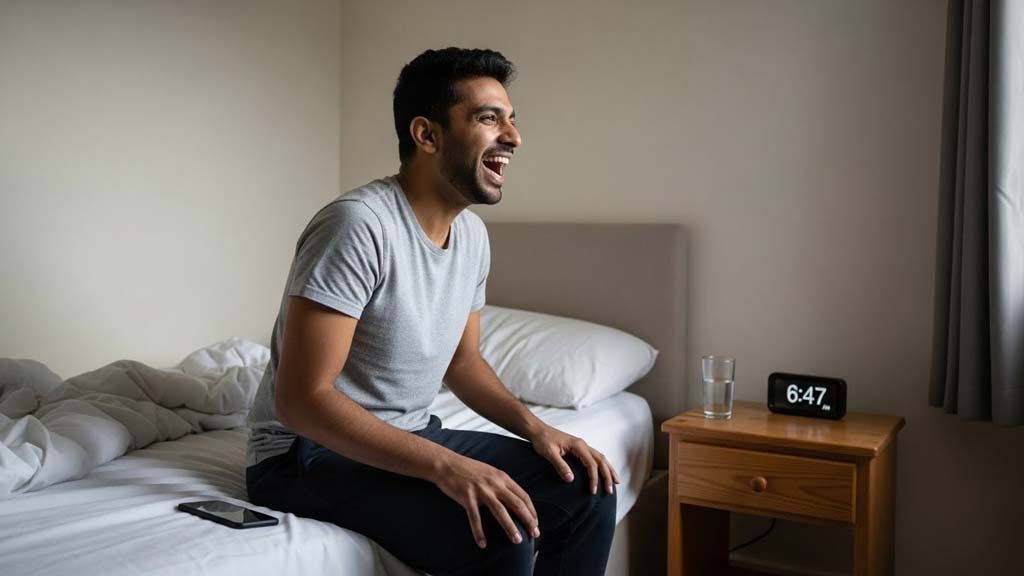
How to laugh more becomes relevant once you understand what laughter does inside your body.
We’ve explored this across three previous posts: firstly, how laughter triggers endorphin release whilst reducing cortisol (the primary stress hormone), creating measurable changes across immune function, pain tolerance, and cardiovascular health. Secondly, the mechanisms underlying stress relief, with cortisol dropping 32-37% after single laughter sessions. Thirdly, research demonstrates that people who rarely laugh face a 49% higher depression risk compared to daily laughers.
The question shifts from “does it work?” to “how to laugh more in daily life?”
Two distinct laughter types exist: spontaneous laughter, which occurs naturally, and structured laughter, deliberately induced through organised interventions. Both share underlying neurophysiological pathways (brain-body communication systems) that confer psychological benefits. Meta-analytic evidence on structured interventions indicates significant depressive symptom reduction.
Clinical applications of solitary laughter for health have been actively explored across multiple healthcare settings worldwide. Laughing alone freely expands laughter’s influence in your life, potentially enhancing self-reliance and resilience. Dr Madan Kataria, founder of laughter yoga, reports routinely laughing alone upon waking, recommending it to make laughter deeply personal and ubiquitous.
The accessibility matters. Laughter therapy requires no specialised equipment and shows no adverse side effects. Studies demonstrate associations between infrequent laughter and heightened functional disability risk amongst older adults.
Practical application requires understanding what types of laughter produce which effects, how often you need to laugh for measurable benefits, and whether simulated laughter works as well as genuine laughter. Three distinct pathways emerge from research: social laughter built into existing activities, solo practices accessible anywhere, and structured programmes offering guided frameworks.
What Different Types of Laughter Actually Mean for Your Health
Understanding how to laugh more effectively starts with recognising different laughter types and their distinct pathways.
Physiological models classify laughter into spontaneous and simulated types, both of which show positive effects. Laughter differs meaningfully from humour. Laughter represents a physical response not exclusively elicited through humour.
Health interventions like laughter yoga, which involve prolonged voluntary laughter, differ from stand-up comedy workshops, where laughter responds to humour. Humour frames more usefully as the object of an emotional state: comic amusement or mirth. Three main categories emerge from research:
- Spontaneous Laughter Through Humour
Spontaneous laughter occurs in response to stimuli. Comedy possesses different dimensions participants engage with: social (joking together), cognitive (getting the joke), emotional (feeling amused), and physical (laughing at the joke).
Humour styles are categorised into four types: self-enhancing, affiliative, self-deprecating, and aggressive. The first two represent non-hostile styles. Self-enhancing humour includes using humour alone. Early psychologists, such as Freud, noted positive functions of solitary laughter, including enjoyment, joy, and gratitude.
Useful nuances between adaptive and maladaptive (harmful or unhelpful) humour uses have been documented. Research indicates humour is commonly, though not exclusively, a source of solitary laughter.
- Simulated Laughter Without Humour
Laughter yoga is a complementary therapy that combines unconditional laughter with yoga breathing practices and stretching poses. Patients laugh differently at jokes or humour programmes. Dr Madan Kataria in India proposed laughter yoga in 1994, incorporating yogic breathing, meditation, and relaxation.
Unlike other forms of yoga, laughter yoga requires no specialised facilities or professional equipment. Simple movements, safety, and low intensity allow practitioners to learn and practise alone quickly. Low cost, high patient participation, and ease of compliance characterise the approach.
Self-induced laughter, including laughter yoga, which combines simulated laughter with deep breathing, requires no humorous stimuli. Previous imaging studies suggest that different neural pathways are involved in stimulated compared to spontaneous laughter.
- Hybrid Approaches
The Self-Initiated Humour Protocol represents a new, self-administered, algorithmic framework for learning to laugh in a non-hostile manner across all life circumstances, enhancing well-being. It synthesises the spontaneous/humorous paradigm with the intentional/self-induced paradigm.
The protocol provides rules for seeing the funny side using the main humour theories: Superiority theory, Incongruity (mismatch between expectation and reality) theory, and Play or Evolutionary theory. Rather than relying on comedy and jokes, or on intentional laughter, the protocol draws on individual mindsets and world interpretations to generate humour.
The majority of human humour occurs spontaneously in everyday life. Laughter as medicine has been recognised for centuries, consistent with human neurodevelopment. Discovering how to laugh more means choosing which approach suits your circumstances and preferences.
How to Laugh More Often: The Dose That Creates Measurable Benefits
Research examining laughter frequency amongst older adults found 43.5% laughed almost every day, 41.2% laughed 1-5 days weekly, 11.9% laughed 1-3 days monthly, and 3.4% never or almost never laughed.
Compared to individuals laughing almost daily, those laughing 1-5 days weekly had 1.25 times higher depression risk. Those laughing 1-3 days per month showed a 1.26 times higher risk. Those who never or almost never laugh faced a 1.49 times higher depression risk.
A significant dose-response trend emerged. Individuals with lower laughter frequency showed higher depression risk. The pattern suggests daily laughter provides optimal protection, though even moderate frequency offers benefits compared to rarely laughing.
Research examining daily laughter found that over 10% occurs in solitude. Baseline data in one intervention found that 70% of participants reported laughing alone. 25% estimated doing so 6 times daily or more.
Session duration and frequency patterns:
- Previous studies used 20-minute comedic videos, but research confirmed constructive effects from viewing even 4-minute clips.
- Single laughter sessions ranging from 9 to 60 minutes reduced cortisol levels by approximately 37% compared to control groups.
- The positive impact on cortisol buffering was evident after one session.
- Participants practising the Self-Initiated Humour Protocol required 20 minutes daily, with chatbot support and a personalised child avatar in virtual reality.
Most cases require at least 9-12 humour training sessions. One study indicated that a six-week laughter therapy programme may have been too short to produce significant changes. Several studies suggested that intervention periods were too short to fully reflect the positive effects.
The intervention group received laughter yoga for four sessions at one-week intervals. Each session lasted 20-30 minutes. Each laugh lasted approximately 30-45 seconds. The four-session programme had a sufficient dose to achieve outcomes.
The duration of most laughter yoga interventions ranged from 4 to 8 weeks. Effects were most pronounced in randomised controlled trials with a 12-week intervention. Ten to fifteen minutes of voiced laughter could increase energy expenditure by 10-40 kilocalories.
Empirical research dating back over 20 years shows that more than 10% of laughter episodes occur alone, generated in various ways. How to laugh more becomes a question of choosing a frequency and format that match your circumstances, rather than finding perfect conditions.
Why it works: Majority of human laughter occurs during conversations, not consuming comedy alone
Access: Requires coordination with others
Cost: Free to low
Why it works: Simulated laughter produces same cortisol reduction as genuine laughter
Access: Anytime, anywhere, no coordination needed
Cost: Free
Why it works: 4-8 week interventions show sustained benefits with guided protocols
Access: Requires programme enrollment or app download
Cost: Free to moderate
Does Simulated Laughter Work as Well as Genuine Laughter?
The question of how to laugh more often raises concerns about whether forced laughter produces the same benefits as spontaneous laughter.
Some scholars believe that real and fake laughter have similar effects on the body. Real or fake laughter exerts a similar effect on the body. Learning how to laugh more through simulated techniques appears as valid as spontaneous approaches.
Laughter yoga, first introduced by an Indian physician, comprised exercises together with laughter. It includes four main steps: clapping and body movement, deep breathing, childlike playfulness, and laughter exercises. Laughter yoga involves deep breathing exercises with hand and foot movements integrated with laughter.
Health benefits of self-induced or simulated laughter have been reported previously. The most common modality is yoga breathing techniques combined with induced laughter exercises, known as laughter yoga. Simulated laughter, not caused by humour or other stimuli, is more effective than spontaneous laughter triggered by humorous stimuli.
The combination of laughter and physical activity could affect the cortisol response. Physical activity itself impacts adrenal hormone secretion (stress hormones produced by glands near the kidneys). Self-induced laughter, including laughter yoga, which combines simulated laughter with deep breathing, requires no humorous stimuli.
Laughter consists of mixed expiration, inspiration, and interval pause patterns. Laughter may have effects similar to exercise. Yogic breathing may enhance relaxation effects.
Most yogic breathing practices shift the autonomic nervous system toward the parasympathetic (calming) branch. Laughter therapies like laughter yoga gain increasing attention. Humour and laughter don’t necessarily occur together.
Evidence suggests that laughter-only therapies may effectively increase well-being and reduce pain across different patient populations. Laughter yoga now operates in many countries. Continuing laughter yoga as a habit proves relatively easy.
Teaching laughter yoga to patients enables self-practice, increasing self-care management. This represents an easy, cost-effective, and affordable way to maintain patients’ mental well-being.

How to Laugh More: Three Pathways That Match Your Life
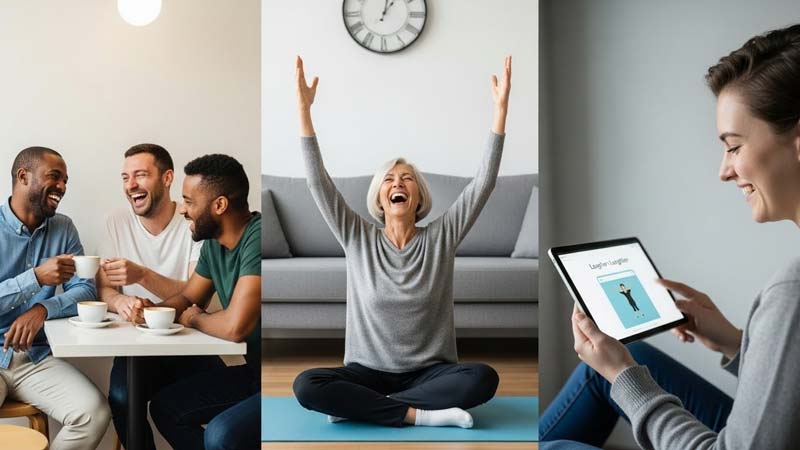
Three distinct approaches emerge from research, each suited to different circumstances and preferences. The pathways aren’t mutually exclusive. You might combine social laughter from exercise groups with morning solo practice, whilst occasionally using structured programmes. The key lies in matching methods to your life rather than forcing your life around rigid approaches.
Pathway 1: Social Laughter (Build It Into Existing Activities)
Social participation through activities like joining exercise groups facilitates interactions and promotes laughter. Increased social interaction may help reduce depression risk by increasing opportunities for laughter.
- Join group exercise classes where conversation naturally occurs between sets or during warm-ups.
- Schedule regular coffee or meal gatherings with friends who naturally make you laugh.
- Participate in community activities to create casual interaction opportunities, such as markets, restaurants, and grocery stores that function as “third places” for older people (locations outside home and work where elastic social ties develop).
- Ensure neighbourhood environments and public open spaces encourage walking or cycling, leading to physical activity, and creating opportunities for social laughter.
The majority of human humour occurs spontaneously in everyday life. Most laughter happens during conversations with friends rather than consuming comedy alone. This social laughter proves more effective for health than solitary laughter while watching television.
Infusing humour and laughter under challenging discussions may represent an essential strategy for protecting health in mid to late life.
Pathway 2: Solo Laughter (Practice Alone, Anywhere)
Anecdotal evidence and empirical data indicate laughing alone merits encouragement as an enjoyable, beneficial experience. Laughing alone freely expands laughter’s influence in your life, potentially enhancing self-reliance and resilience.
Solo laughter can be spontaneous, provoked, or self-induced. Complete solitary laughter may occur without readily identifiable humour, identified with experiences of novelty and joy. Laughter represents an exercise that provides physiological and mood-enhancing benefits, promoting overall well-being.
Deliberate, self-induced laughter alone, without recourse to humour, extends therapeutic group laughter beyond communal settings. The earliest reported use of solitary laughter in mental health practices was laughter meditation.
- Morning practice: Dr Madan Kataria reports routinely laughing alone upon waking, recommending it to render laughter deeply personal and ubiquitous.
- One-minute Laughie prescription: Developed in 2017, emphasising the importance of laughing alone, though also undertaken with others and groups. Assisted solitary laughter uses smartphones to help induce and sustain laughter.
- Throughout daily routines, recommended therapeutic laughter often doesn’t rely on external humour to elicit laughter but instead seeks to derive psychophysiological benefits from laughter itself.
- Self-administered programmes: The Self-Initiated Humour Protocol provides algorithmic frameworks that allow individuals to learn to laugh in non-hostile ways. It develops a sense of humour across all possible life contexts, enabling self-administration through interaction with AI agents.
The self-administered nature makes it suitable for delivery via digital technologies, such as virtual reality and emotionally intelligent chatbots. Conversational agents offer accessible, scalable, and personalisable platforms for digital healthcare, particularly by deploying psychotherapeutic interventions through conversational interactions with users, providing protocol-relevant support and recommendations.
Pathway 3: Structured Programmes (Guided Frameworks and Digital Tools)
Humour therapy is defined as interventions that promote physical well-being whilst fostering emotional, cognitive, social, or spiritual healing through playful discovery, expression, or appreciation of absurd or incongruous life situations. Humour therapy helps people cope with stress, regulate emotions, and promote physical and mental health.
Intervention contents and types vary: reading interesting books and cartoons; watching witty plays and comic videos; sharing anecdotes; instructing in facial muscle relaxation; laughter; meditation; encouraging singing and dancing together; role-playing; and clown performances. Studies focused on three intervention types: humour therapy, medical clowning, and laughter therapy.
Humour therapy interventions included showing participants comedy videos or films, with Laughter Bosses and Elder Clowns interacting through music, jokes, slapstick, or simple conversation in one-on-one or group formats. Medical clowns entertained children through interruptions, soap bubbles, magic tricks, puppets, pantomime, prestidigitation, juggling, and improvisation.
Outcomes indicated that interventions using short comedic videos improve focus and may reduce psychological stress. Results support the clinical benefits of humour, utilised as simple, non-invasive approaches to promote health. Enjoyable interventions serve as practical approaches to resolving stress-induced inattentiveness in everyday life, contributing to improving cognitive functions and mental health.
Humour therapy is gaining recognition as a cost-effective, safe, and efficient intervention that enhances physical and mental health and social well-being. Medical clowns create more positive atmospheres between medical teams and patients by conveying a sense of humour through whimsical antics, comedy, and improvisation.
Humour therapy is combined with specific technological applications and treatments in some cases and situations. Apps, video recordings, and live guidance compensate for drawbacks when therapy cannot be fully implemented, making technology the best way to reach more patients.
The 7 Humour Habits Programme by Paul McGhee aims to enhance humour as a coping skill for life stress and to increase positive affect in everyday life. Initial findings suggest mental health professionals could investigate laughter therapy themselves, supporting patients in enhancing well-being, autonomy, and resilience.
Learning how to laugh more through these pathways provides accessible entry points regardless of your current laughter frequency. The 49% reduction in depression risk for daily laughers compared to those who never laugh represents substantial protection, requiring no equipment and costing nothing. Each pathway offers practical methods for translating research into daily practice.
The evidence shows that how to laugh more depends less on perfect conditions than on choosing approaches that match your life. Daily laughter provides optimal protection, though even moderate frequency offers measurable benefits. Single sessions produce cortisol reductions. Four-week programmes show sustained improvements. The choice between spontaneous and simulated laughter matters less than consistency in whichever pathway you choose.
Sources
- Bains, G.S., Berk, L.S., Lohman, E., Daher, N., Petrofsky, J., Schwab, E., et al. Humors effect on short-term memory in healthy and diabetic older adults. Altern Ther Health Med. 2015;21:16–25
- Eda, N., Ito, H., Akama, T. (2020). Beneficial Effects of Yoga Stretching on Salivary Stress Hormones and Parasympathetic Nerve Activity. J Sports Sci Med 19(4):695–702
- Fessell, D. (2020). Laughter Leaves Me Lighter: Coping With COVID-19. JAMA. 323(24):2476–2477.
- Ghodsbin, F., Sharif Ahmadi, Z., Jahanbin, I., & Sharif, F. The effects of laughter therapy on general health of elderly people referring to Jahandidegan community center in Shiraz, Iran, 2014: A randomised controlled trial. International Journal of Community Based Nursing and Midwifery, 3(1), 31–38
- Gonot-Schoupinsky, F.N., Garip, G. Prescribing laughter to increase well-being in healthy adults: an exploratory mixed methods feasibility study of the Laughie. Eur J Integr Med. 2019;1(26):56–64
- Kataria, M., Ben-Moshe, R., Gonot-Schoupinsky, F. Laughter and mental health: a case study of Dr Madan Kataria. Ment Health Soc Incl. 2023;27(3):220–9
- Ko, H.J., Youn, C.H. Effects of laughter therapy on depression, cognition, and sleep among the community-dwelling elderly. Geriatr Gerontol Int. 2011;11:267–74
- Kuru Alici, N., Arikan Dönmez, A. (2020). A systematic review of the effect of laughter yoga on physical function and psychosocial outcomes in older adults. Complement Ther Clin Pract. 41:101252.
- Kuru Alici, N., Gonot-Schoupinsky, F., Garip, G. A pilot study investigating the feasibility, reach-out, acceptability, fidelity, and efficacy of a group Laughie prescription on the well-being of earthquake survivors in Türkiye. Issues Ment Health Nurs. 2024;45(11):1210–7
- Lee, Y. J., Kim, M. A., & Park, H.‐ Effects of a laughter programme with entrainment music on stress, depression, and health‐related quality of life among gynaecological cancer patients. Complementary Therapies in Clinical Practice, 39, 101118
- Martin, R.A., Kuiper, N.A. Daily occurrence of laughter: relationships with age, gender, and Type A personality. Humor. 1999;12(4):355–84
- Martin, R. A. (2007). The psychology of humor: An integrative approach (Burlington, MA: Elsevier Academic)
- Martin, R.A., Puhlik-Doris, P., Larsen, G., Gray, J., Weir, K. Individual differences in uses of humor and their relation to psychological well-being: development of the humor styles questionnaire. J Res Pers. (2003) 37:48–75
- Mathevon, N., Koralek, A., Weldele, M., Glickman, S. E., Theunissen, F. E. (2010). What the hyena’s laugh tells: sex, age, dominance and individual signature in the giggling call of Crocuta crocuta. BMC Ecol. 10, 1–16.
- Mora-Ripoll, R. (2011). Potential health benefits of simulated laughter: a narrative review of the literature and recommendations for future research. Complement. Ther. Med. 19, 170–177.
- Mora-Ripoll, R. Simulated laughter techniques for therapeutic use in mental health. J Psychol Clin Psychiatry. 2017;8(2):1–4
- Morishima, T., Miyashiro, I., Inoue, N., Kitasaka, M., Akazawa, T., Higeno, A., Idota, A., Sato, A., Ohira, T., Sakon, M. (2019). Effects of laughter therapy on quality of life in patients with cancer: an open-label, randomised controlled trial. PLoS ONE. 14(6):e0219065.
- Namazinia M, Mazlum SR, Mohajer S, Lopez V. Effects of laughter yoga on health-related quality of life in cancer patients undergoing chemotherapy: a randomised clinical trial. BMC Complement Med Ther. 2023 Jun 12;23(1):192.
- Sutorius, D. The transforming force of laughter, with the focus on the laughing meditation. Patient Educ Couns. 1995;26(1–3):367–71
- Tamada, Y., Takeuchi, K., Yamaguchi, C., Saito, M., Ohira, T., Shirai, K., et al. Does laughter predict the onset of functional disability and mortality among older Japanese adults? The JAGES prospective cohort study. J Epidemiol. 2021;31:301–7
- Tsuji, T., Kanamori, S., Watanabe, R., et al. Types of sports and exercise group participation and sociopsychological health in older adults: a 3-yr longitudinal study. Med. Sci. Sports Exerc., 54 (10) (2022), pp. 1657-1664
- van der Wal, C.N., Kok, R.N. Laughter-inducing therapies: systematic review and meta-analysis. Soc. Sci. Med., 232 (2019), pp. 473-488
- Weeks, M., Gonot-Schoupinsky, F. Mental health and positive introversion: a positive autoethnographic case study of Mark Weeks. Ment Health Soc Incl. 2024;29(1):31–42
- Yazdani, M., Esmaeilzadeh, M., Pahlavanzadeh, S., Khaledi, F. (2014). The effect of laughter yoga on general health among nursing students. Iran J Nurs midwifery Res. 19(1):36
- Yim, J. (2016). Therapeutic benefits of laughter in mental health: a theoretical review. Tohoku J Exp Med. 239(3):243–9.